

62.3K Total Clicks for a Web Hosting Company in Gurugram in 7 Months
This Gurugram-based hosting company had strong products but minimal organic visibility. No rankings for hosting-related keywords, no traffic from search. Here is exactly what the audit found, what I did, and what the GSC data showed over 7 months.
A Hosting Company With a Strong Product and No Organic Search Presence
This client runs a web hosting company based in Gurugram. They offer shared hosting, VPS, and dedicated server plans to businesses and developers across India. The product was competitive on price and features. The problem was that almost nobody was finding them through organic search.
When I first looked at their Google Search Console data, organic traffic was negligible. The site had no rankings for any commercially meaningful hosting-related keywords. Buyers who were actively comparing hosting providers in India were finding competitors, not this client. Previous digital marketing efforts had produced no measurable results from organic search.
Web hosting is one of the most competitive SEO niches in India. You are competing against global brands like Bluehost and Hostinger that have spent years and significant budgets building domain authority. The strategy had to be built around what an Indian hosting provider can own that global brands cannot: local relevance, India-specific pricing content, and the trust signals that matter to Indian buyers when choosing a hosting provider.
What the Audit Revealed
I ran a full audit using Screaming Frog, Ahrefs, and Google Search Console. Four problem areas, each with a direct reason why the site was not ranking in a niche where the competition is fierce.
Technical Issues
- Core Web Vitals failing on both mobile and desktop — a significant problem for a hosting company, where page speed is a direct trust signal to buyers evaluating performance
- Crawl errors on hosting plan pages — the exact pages buyers land on to make a purchase decision were not being reliably indexed
- No structured data markup on plan pages — a missed opportunity for Product schema that could generate rich results in hosting comparison searches
- Internal linking sparse — plan pages, feature pages, and blog posts were not connected in any logical structure
On-Page Issues
- Hosting plan pages had thin content — feature lists with no explanation of why those features matter to the buyer, making the pages invisible for informational and comparison queries
- No keyword differentiation between plan pages — shared hosting, VPS, and dedicated server pages were targeting overlapping terms, causing internal cannibalisation
- Meta titles generic and duplicated across multiple plan variants — Google had no clear signal about which page to rank for which hosting query
Content Gaps
- No comparison content — buyers searching "best web hosting India", "cheap hosting India", or "hosting comparison India" found nothing from this brand, sending them directly to competitors
- No India-specific content addressing the questions Indian buyers ask: pricing in rupees, data centre location, payment methods, customer support in Indian time zones
- No use-case content targeting the specific buyer segments: WordPress hosting for bloggers, business hosting for small companies, developer hosting for agencies
Authority Gaps
- Backlink profile weak relative to competitors — global hosting brands had thousands of referring domains, this site had a fraction of that, making it difficult to rank on any competitive hosting term
- No links from Indian technology, business, or web development publications that would signal local relevance to Google for India-specific hosting searches
- No presence in Indian hosting review platforms and comparison sites that send both authority signals and direct buyer referral traffic
What I Did and Why I Did It in This Order
Competing against global hosting brands on generic terms is a slow path for an Indian provider. The faster path is owning the India-specific search space that global brands treat as secondary: local pricing, local support, local data centre relevance. That is where the strategy was built.
Technical Fixes and Plan Page Architecture
I fixed the Core Web Vitals failures first because in web hosting, page speed is a trust signal. A hosting company with a slow website sends a contradictory message to buyers who are evaluating whether to trust that company with their own website performance. Speed fixes came first for both SEO and conversion reasons.
Fixed all crawl errors on plan pages. Restructured internal linking to connect plan pages, feature pages, and blog posts in a logical hierarchy. Added Product schema to all hosting plan pages to signal to Google what each page was offering and at what price point, creating the foundation for rich result eligibility in comparison searches.
Keyword Strategy Built Around Indian Buyer Intent
I built the keyword strategy around one principle: Indian buyers search for hosting differently from buyers in the US or UK. They search with India-specific modifiers: "web hosting India", "cheap hosting India", "best hosting for WordPress India", "hosting with Indian data centre". These terms had meaningful search volume and significantly lower competition than the global equivalents.
Each plan type was assigned its own keyword cluster with clear differentiation. Shared hosting targeted small business and blogger queries. VPS targeted developer and agency queries. Dedicated server targeted enterprise and high-traffic site queries. This eliminated the cannibalisation that had been making all three plan pages rank poorly for everything.
Plan Pages Rebuilt and Comparison Content Launched
Every plan page was rewritten. Thin feature lists became comprehensive pages explaining what each feature meant for the buyer's specific use case, why the pricing was structured the way it was, and what type of website or business each plan was built for. Pages that had 150 words became 600 to 800 words of buyer-relevant content with clear calls to action.
The comparison content programme launched simultaneously. The reason comparison content was the first content type I built is that buyers in the hosting niche are highly comparison-driven. They search "X vs Y hosting" before they decide. If you are not present in that comparison research phase, you lose the buyer before they ever reach your plan page. The first pieces targeted the most searched comparisons in the Indian hosting market.
India-Specific Content and Link Acquisition
From month 2 I published India-specific content monthly: guides on choosing hosting for Indian businesses, WordPress hosting comparisons for Indian bloggers, and use-case guides for Indian agencies and developers. Each piece was written to answer the question completely and link back to the relevant plan page once the reader was ready to act.
Link acquisition focused on Indian technology publications, web development blogs, and business directories with Indian readership. The reasoning was clear: a link from an Indian technology publication is a more direct authority signal for Indian hosting searches than a link from a generic international directory. By month 7 the referring domain profile had grown meaningfully with contextually relevant Indian sources.
What the GSC Data Showed Over 7 Months
All data from Google Search Console. Verified numbers, real timeline.
How the Growth Unfolded
Months 1 and 2 were the foundation phase. Technical fixes applied, plan pages rebuilt, comparison content launched. Traffic movement was minimal while Google recrawled and reassessed the site. This is standard behaviour after significant on-page changes and should not be interpreted as the strategy not working. The foundation phase exists to give Google accurate signals before it commits to rankings.
Month 3 saw the first meaningful rankings appear. The rebuilt plan pages began appearing for their target keyword clusters. The comparison content started generating impressions for buyers in the research phase. The 2.43M total impressions over 7 months reflects a site that moved from invisible to consistently appearing across a wide range of hosting-related searches in India.
The average position of 38.9 reflects the reality of competing in a niche dominated by global brands with significant authority advantages. The 2.6% CTR at that average position is the meaningful number. It shows that when the site did appear in search results, users were clicking. The content was matching search intent well enough to earn clicks from positions that would normally underperform. The 62.3K total clicks is the result of that combination over 7 months.
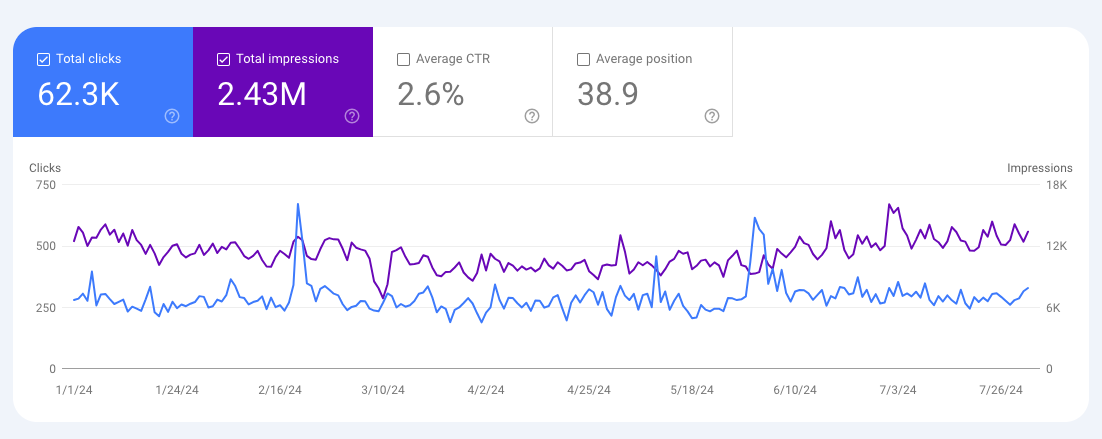
Google Search Console — 62.3K total clicks, 2.43M impressions, 7 months
If Your Business Competes in a Niche Dominated by Large Brands
The lesson from this case study applies beyond hosting. Any business competing in a niche where large brands dominate the generic terms needs the same strategic approach: identify the search space your competitors treat as secondary and build depth there. For this hosting company, that space was India-specific content and local relevance signals.
The average position of 38.9 is not a failure metric. It is an honest reflection of where a smaller brand realistically sits against global authority in 7 months. The 2.6% CTR and 62.3K total clicks at that average position are the performance metrics that matter. Content that earns clicks from low average positions is content that matches what the searcher actually wanted to find.
If your business is invisible in organic search because larger competitors dominate your core terms, the free SEO audit will identify the specific search spaces where you can build visibility and what content and technical changes are needed to get there.
Want to Build Visibility in a Competitive Niche?
Start with a free SEO audit. I will review your site technically, identify the keyword spaces your competitors are ignoring, and send you a prioritised report within 5 working days. No obligation. You keep the report either way.
Get Your Free SEO Audit