

325K Total Clicks for a LASIK Eye Surgery Practice in Delhi in 11 Months
This ophthalmology practice had an existing website but zero organic visibility. No traffic from surgery keywords, no patient enquiries from Google, and months of previous SEO work with nothing to show for it. Here is exactly what I found, what I did, and what the numbers looked like month by month.
An Ophthalmology Practice With a Website Nobody Could Find
This client runs an ophthalmology practice in Patel Nagar, West Delhi. The clinic offers LASIK surgery, cataract procedures, and general eye care. They had invested in a professional website and had been paying for SEO services for several months before approaching me.
When I first looked at their Google Search Console data, the picture was stark. The site was receiving roughly 106,000 monthly visitors, but almost none of that traffic was coming from surgery-related searches. The bulk of their impressions were for low-intent informational queries that were never going to convert into consultation bookings. For the specific keywords that matter to a LASIK practice, the site was essentially invisible.
Their previous SEO provider had produced monthly reports showing keyword lists and tasks completed. What was missing was any connection between those activities and actual patient enquiries. The clinic owner was frustrated. They were paying for SEO, their reports looked busy, but the phone was not ringing from Google.
What I Found When I Audited the Site
I ran a full audit using Screaming Frog for technical crawl issues, Ahrefs for backlink profile and keyword gap analysis, and Google Search Console for performance data. Here is what the audit revealed across four areas.
Technical Issues
- Page speed failing Core Web Vitals on mobile, LCP over 4.2 seconds
- Missing schema markup for MedicalBusiness, Physician, and MedicalProcedure
- Duplicate meta descriptions across 14 service pages
- No XML sitemap submitted to Search Console
- Images uncompressed, no lazy loading, no WebP conversion
On-Page Issues
- H1 tags on key pages targeting generic terms like "eye hospital Delhi" rather than procedure-specific queries
- LASIK landing page had 180 words, insufficient to establish topical authority for a complex surgical procedure
- Internal linking structure did not connect informational content to conversion pages
- No FAQ sections on procedure pages despite high question-based search volume
Content Gaps
- No content targeting the decision-stage queries patients use before booking LASIK: cost questions, recovery time, candidacy requirements
- Competitor clinics ranking above them had 10 to 15 blog posts answering patient questions, this site had none
- No content differentiating the surgeon's experience and credentials, a major trust signal for medical searches
Local SEO Gaps
- Google Business Profile incomplete, no services listed, no photos of the clinic, no Q&A responses
- NAP (Name, Address, Phone) inconsistencies across 6 directories
- Zero reviews responded to, a missed trust signal that affects local pack eligibility
- Not appearing in Local Pack for "LASIK surgeon Patel Nagar" or adjacent locality searches
What I Did, and Why I Did It in This Order
The order matters as much as the work itself. Most SEO consultants start with link building. I start with the foundation. Links pointing to a technically broken site with thin content produce almost nothing.
Technical Foundation First
I fixed the Core Web Vitals failures before anything else. Compressed and converted all images to WebP. Implemented lazy loading on below-fold images. Resolved the duplicate meta description issue across all service pages. Submitted a clean XML sitemap and fixed crawl errors blocking indexation of the LASIK landing page.
I also implemented MedicalBusiness schema on the homepage, MedicalProcedure schema on each procedure page, and Physician schema for the surgeon profile. This is a Google E-E-A-T signal specific to medical content and it matters significantly for healthcare sites. Google's quality rater guidelines treat medical content as YMYL (Your Money Your Life) and apply stricter trustworthiness standards.
Keyword Strategy Built Around Patient Intent
I rebuilt the keyword strategy from scratch. The previous approach had targeted broad terms like "eye hospital Delhi", high volume, low conversion, and dominated by large hospital groups with authority this clinic could not compete with.
Instead I mapped keywords to patient decision stages. Awareness stage: "what is LASIK surgery", "LASIK vs glasses which is better". Consideration stage: "LASIK surgery cost in Delhi", "LASIK surgery recovery time", "am I a good candidate for LASIK". Decision stage: "best LASIK surgeon Patel Nagar", "LASIK clinic West Delhi". Each page was assigned its own target query cluster with no overlap.
LASIK Page Rebuilt, Content Programme Started
The LASIK landing page was rebuilt from 180 words to a comprehensive procedure page covering: what the procedure involves, candidacy criteria, what to expect before and after, the surgeon's specific experience and number of procedures performed, and a detailed FAQ section targeting the 12 most searched questions about LASIK in Delhi.
I began the patient-focused content programme simultaneously. The first three posts targeted the highest-volume consideration keywords: LASIK cost in Delhi, LASIK recovery timeline, and LASIK vs contact lenses. Each post was written to answer the question completely rather than to drive the reader to book. Trust-first content converts better in healthcare than sales-first content.
GBP Overhaul and Ongoing Content
I overhauled the Google Business Profile completely. Added all services with procedure-specific descriptions. Uploaded 24 clinic photos. Built out the Q&A section with the questions patients actually ask before calling. Corrected NAP inconsistencies across all directories. Set up a review response process with the clinic team.
From month 2 onwards I published 2 to 3 patient content pieces monthly. The internal linking strategy connected all informational content back to the LASIK and cataract landing pages, building topical authority progressively. By month 3 the clinic was appearing in the Local Pack for Patel Nagar and adjacent locality searches.
What the Numbers Looked Like Month by Month
All data is from Google Search Console. These are real traffic numbers, not keyword ranking estimates or traffic tool approximations.
How the Growth Unfolded
Months 1 and 2 were the foundation phase. Traffic numbers did not move significantly. This is normal and expected. Technical fixes were applied, schema implemented, the LASIK page rebuilt. Google needs time to recrawl and reindex changes before they register in traffic data.
Month 3 was when the first movement appeared. The rebuilt LASIK page began ranking in positions 8 to 12 for the core procedure terms. The Local Pack visibility for Patel Nagar locality searches appeared. Total clicks were building steadily through this phase.
Months 4 and 5 accelerated. The content programme was generating rankings for the consideration-stage queries: LASIK cost, recovery questions, candidacy guides. These pages were bringing in traffic at different stages of the patient decision journey, not just the bottom-funnel visitors. Click volume continued accelerating month on month.
Month 6 saw the compounding effect that good SEO produces when the foundation, content, and local signals all work together. By month 11 the site had reached 325K total clicks. The clinic had moved from invisible on surgery-specific searches to ranking on page 1 for their core procedure terms in Delhi.
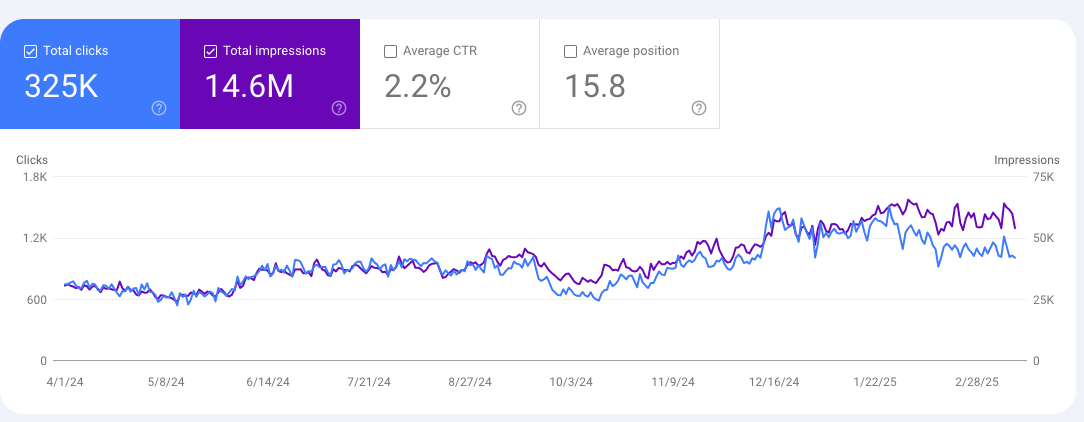
Google Search Console, 325K total clicks, 14.6M impressions, 11 months
If You Run a Healthcare Practice in Delhi
The problems this LASIK practice had are not unique to eye surgery. I see the same issues with dental clinics in South Delhi, physiotherapy practices in Dwarka, dermatology clinics in Greater Kailash, and diagnostic centres in Rohini. The website exists, sometimes with significant investment, but the foundation is wrong and no one has fixed it.
Healthcare SEO in Delhi is harder than most niches because Google holds medical content to stricter standards. Your content needs to demonstrate that a qualified professional wrote it or reviewed it. Your site needs to load fast enough to not frustrate patients who are already anxious. Your Google Business Profile needs to give a first-time patient enough confidence to pick up the phone.
The 325K total clicks figure is from Google Search Console. Before I started, the site had no visibility for surgery-specific searches. That changed completely. If your practice is in a similar position, the free SEO audit will tell you exactly where you stand and what needs to change.
Want Results Like This for Your Healthcare Practice?
Start with a free SEO audit. I will review your site technically, check your content against patient search intent, and audit your Google Business Profile. You get a prioritised report within 5 working days. No obligation. You keep the report either way.
Get Your Free SEO Audit