

22.1K Total Clicks for a Luxury Expat Real Estate Brand in Delhi NCR in 12 Months
This real estate brand had near-zero organic presence when I started. No rankings for property-related keywords, no leads from search, no SEO foundation to build on. Here is exactly what I found, what I built from scratch, and what the GSC data showed over 12 months.
A Property Brand With No Organic Presence in One of Delhi's Most Competitive Niches
This client operates in the luxury expat property segment in Delhi NCR. Their business serves international professionals and expat families relocating to Delhi who are looking to buy or invest in high-value residential property. It is a specific, high-intent audience with specific search behaviour.
When I first pulled their Google Search Console data, the site had minimal organic visibility. The existing website was not ranking for any meaningful property-related keywords. Traffic from organic search was negligible. There were no enquiries coming through from Google. Previous SEO work had been done but produced no measurable results and left no clear foundation to build on.
Real estate SEO in Delhi NCR is genuinely difficult. You are competing against property portals like MagicBricks, 99acres, and Housing that have domain authority built over decades and marketing budgets this client could not match. The strategy had to be built around what a specialist brand can own that portals cannot: depth, trust, and niche authority.
What the Audit Revealed
I ran a full audit using Screaming Frog, Ahrefs, and Google Search Console. Four areas with clear problems, each requiring a different fix.
Technical Issues
- No schema markup for RealEstateAgent or PropertyListing — a missed structured data opportunity in a schema-rich niche
- Crawl depth issues — key property pages buried 4 to 5 clicks from the homepage, limiting Google's ability to index them
- Page speed failing on mobile — images unoptimised, no lazy loading, LCP above acceptable thresholds
- No XML sitemap submitted to Search Console — Google had to discover pages by crawling rather than being guided
On-Page Issues
- Property pages had thin content — 100 to 200 words per page with no keyword strategy, making them invisible for any meaningful search query
- H1 tags generic — "Properties in Delhi" rather than area-specific and buyer-intent terms that expats actually search
- No internal linking structure — property pages were isolated from each other with no topical signals connecting them
- Meta titles duplicated across multiple property type pages, creating cannibalisation
Content Gaps
- No content targeting expat-specific search queries — terms like "property for expats Delhi", "buying property in Delhi as foreigner", "luxury apartments Delhi NCR" had zero coverage
- No area guides for the neighbourhoods expat buyers actually target — Greater Kailash, Golf Links, Vasant Vihar, Gurgaon
- No investment content addressing the questions high-value buyers ask before committing to a purchase in India
Authority Gaps
- Backlink profile minimal — fewer than 20 referring domains, mostly irrelevant, with no links from property or investment publications
- No presence in any real estate or investment directories that send both referral traffic and authority signals
- Competing portal pages had 200 to 500 referring domains — the authority gap was significant and required a deliberate link acquisition strategy
What I Built and Why I Built It in This Order
Competing against property portals on their own terms is a losing strategy for a specialist brand. The approach was to build depth and niche authority in the expat buyer segment, an area the portals cover broadly but never in detail.
Technical Foundation and Site Architecture
Fixed all crawl depth issues first, restructured internal linking so no important property page was more than two clicks from the homepage. Submitted a clean XML sitemap. Fixed page speed by compressing and converting all images to WebP, implementing lazy loading on below-fold content, and eliminating render-blocking resources.
Implemented RealEstateAgent schema on the main pages and RealEstateListing schema on individual property pages. This gave Google structured signals about what the site was and what each page represented, which is particularly important in real estate where Google tries to understand listing data precisely.
Keyword Strategy Built Around Expat Buyer Intent
The keyword strategy was built around one insight: expat buyers search differently from local buyers. They use terms like "property for expats Delhi", "international standard apartments Delhi NCR", "gated communities Delhi for foreigners", and neighbourhood names they have been told to look at by their relocation agent.
I mapped three tiers of keywords. Top of funnel: neighbourhood guides and area comparisons. Middle of funnel: property type searches and investment guides. Bottom of funnel: buyer-intent terms with area specifics. Every existing page was assigned a primary keyword cluster. Content gaps were mapped to new pages to be created.
Property Pages Rebuilt, Content Programme Launched
Every key property page was rewritten from the ground up. 100-word thin pages became 600 to 800-word pages covering property specifications, neighbourhood context, transport links, schools and amenities relevant to expat families, and investment considerations. Each page targeted a specific keyword cluster with no overlap between pages.
The content programme launched with area guides for the five neighbourhoods expat buyers search most: Greater Kailash, Vasant Vihar, Golf Links, DLF Phase 5 Gurgaon, and Unitech South City. These guides were not keyword-stuffed listings. They were genuine relocation resources that answered the questions an expat buyer actually has before committing to a neighbourhood.
Investment Content and Link Acquisition
From month 2 I published investment-focused content monthly: guides on the legal process for foreign nationals buying property in India, NRI investment guides, ROI comparisons between Delhi NCR areas, and rental yield analyses for expat landlords. This content attracted the highest-value audience: people with real purchase intent, not just browsing.
Simultaneously I ran a focused backlink acquisition campaign targeting property, finance, and expat lifestyle publications. Each link acquisition was contextually relevant, not generic directory submissions. The referring domain count grew from under 20 to over 80 by month 12, building the authority foundation that sustained rankings even in a portal-dominated niche.
What the GSC Data Showed Over 12 Months
All data from Google Search Console. Real traffic, real timelines, verified numbers.
How the Growth Unfolded
The first two months were the rebuild phase. Technical fixes applied, site architecture restructured, property pages rewritten. No significant traffic movement. This is normal and expected. Google needs time to recrawl, reindex, and reassess a site after structural changes. Clients who panic in this phase and demand changes are the ones who never see the compound growth that follows.
Months 3 and 4 saw the first movement. The rebuilt property pages started appearing in positions 15 to 25 for their target keyword clusters. The area guides began picking up impressions. This is the phase where Google is testing the new content against user signals: are people clicking? Are they staying on the page? The content was written to earn both.
Months 5 through 8 were the acceleration phase. The investment content was generating organic traffic from high-intent searchers. The area guides were establishing topical authority in the expat property space. The backlink acquisition was building the domain authority signals that allowed rankings to hold even against portal competition. Click volume grew consistently month on month through this period.
Months 9 through 12 showed the compounding effect. The 1.81M impressions and 22.1K total clicks reflect a site that had moved from effectively invisible to ranking consistently across a wide range of expat buyer search queries. The average position of 19.2 reflects the reality of competing in a portal-heavy niche, but the click volume shows that the right queries were being captured at the right intent stage.
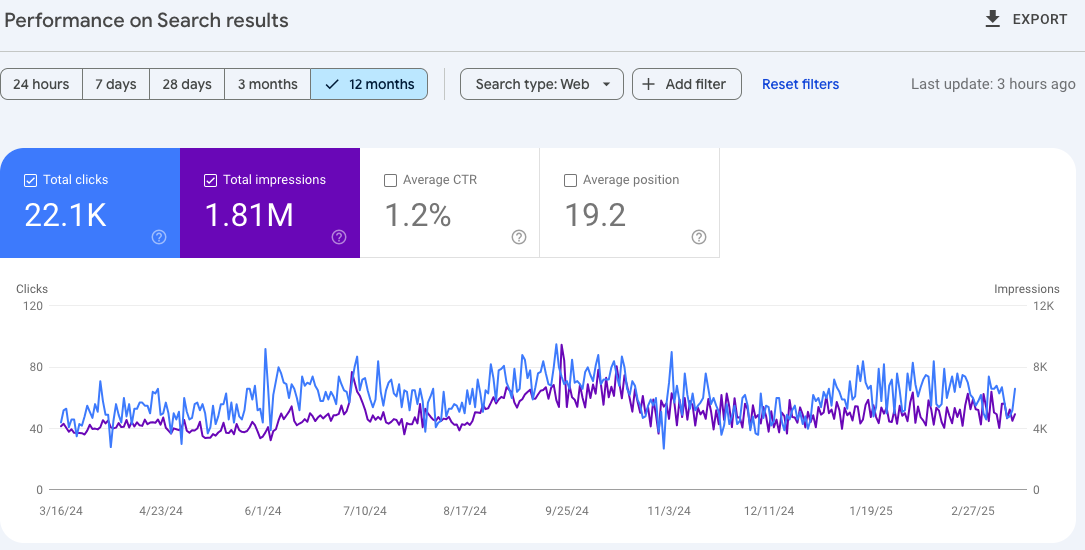
Google Search Console — 22.1K total clicks, 1.81M impressions, 12 months
If You Work in Real Estate in Delhi NCR
The lesson from this case study is not that you can outrank MagicBricks or 99acres on their own terms. You cannot and should not try. What you can own is depth in your specific segment. A portal lists every property in Delhi. You are the expert in one niche, one buyer type, one area, one price range. SEO strategy for real estate agents and developers in Delhi NCR needs to reflect that positioning.
The queries that drive qualified leads for a specialist real estate brand are not the same high-volume terms the portals compete for. They are the specific, intent-rich searches that indicate someone is serious about buying or investing. These are the queries where a specialist can rank and convert against portals that treat every search as equally valuable.
If your real estate business in Delhi NCR is not generating enquiries from organic search, the free SEO audit will tell you exactly which queries your potential buyers are using, where you are invisible, and what needs to change.
Want Results Like This for Your Real Estate Business?
Start with a free SEO audit. I will review your site technically, analyse your keyword gaps against the queries your buyers actually use, and send you a prioritised report within 5 working days. No obligation. You keep the report either way.
Get Your Free SEO Audit