

52K Total Clicks for a Global Staffing Company Across 3 Countries in 6 Months
This staffing company needed to rank simultaneously in three competitive international markets with different search behaviour, different competition levels, and different candidate intent. No previous SEO had worked. Here is exactly what I found, why I built the strategy I did, and what the GSC data showed over 6 months.
A Staffing Company With No Organic Visibility Across Three International Markets
This client runs a global staffing and recruitment company placing candidates across Ireland, Kuwait, and Germany. Three countries. Three distinct job markets. Three different sets of search behaviour from candidates actively looking for international work opportunities.
When I first audited their Google Search Console data, the picture was the same across all three markets: negligible organic visibility. The website existed but was not ranking for any meaningful recruitment-related keywords in any of the three target countries. Organic search was generating almost no candidate enquiries. Previous SEO and digital marketing work had produced no measurable results and left no usable foundation.
The core challenge here was one that most SEO consultants handle badly: multi-country SEO requires a fundamentally different architecture than single-country SEO. You cannot simply publish the same content and expect it to rank in three countries with different Google algorithms, different competitor landscapes, and candidates using different search terms to find the same type of job. The strategy had to treat each country as a separate SEO project while building a coherent site structure that connected them.
What the Audit Revealed Across All Three Markets
I ran the full audit using Screaming Frog for technical issues, Ahrefs for keyword gaps and competitor analysis per country, and Google Search Console for performance data. Four distinct problem areas, each with a direct impact on why the site was invisible.
Technical Issues
- No hreflang implementation at all — Google had no signal about which pages targeted which countries, so it was serving the wrong content to the wrong audiences in search results
- No country-specific URL structure — all three markets were served from the same pages with no geographical targeting in either the site architecture or Search Console settings
- Crawl errors blocking key job category pages from indexation — pages that should have been ranking were not even in the index
- Mobile performance failing — LCP above threshold, unoptimised images, no lazy loading
On-Page Issues
- Generic job category pages with 100 to 150 words — not enough content to establish relevance for any specific search query in any of the three markets
- No country-specific keyword targeting — a candidate searching for jobs in Ireland uses different terms than one searching for jobs in Kuwait or Germany
- No EmploymentAgency or JobPosting schema markup — a significant missed opportunity in a sector where structured data directly influences search result appearance
- Internal linking disconnected — country pages, job category pages, and the homepage had no logical linking structure
Content Gaps
- No country-specific landing pages — Ireland, Kuwait, and Germany each needed dedicated pages targeting the specific search queries candidates in those markets use when looking for international recruitment agencies
- No industry-specific content for the sectors this agency specialises in: healthcare, engineering, and hospitality, the three sectors with the highest candidate search volume across their target markets
- No content addressing the questions candidates ask before registering with an international recruiter: visa process, salary expectations, relocation guidance
International SEO Gaps
- No geo-targeting configured in Google Search Console — Google was not receiving explicit country targeting signals for any of the three markets
- Backlink profile with no international relevance — no links from Irish, Kuwaiti, or German industry publications that would signal authority in those specific markets
- No country-specific trust signals — local phone numbers, local addresses, and local industry associations that Google uses to verify geographic relevance were completely absent
What I Built and Why Each Decision Was Made
Multi-country SEO fails when consultants apply a single-country playbook across multiple markets. The reason is simple: Google evaluates relevance, authority, and trust separately for each country. Building for three markets simultaneously requires treating each as a distinct project while maintaining a shared technical foundation.
Technical Foundation and Hreflang Architecture
The first and most critical fix was hreflang implementation. Without it, Google was serving the same page to candidates in all three countries regardless of their location, which meant no page was optimised for any specific market. I implemented hreflang tags across the entire site, mapping each page to its correct target country and language, and configured geo-targeting in Google Search Console for each market separately.
The reason I prioritised hreflang before any content work is that content improvements are wasted if Google cannot determine which country a page targets. You can write the best recruitment content for the Irish market, but if Google is also serving it to candidates in Kuwait and Germany, the relevance signal is diluted and rankings in all three markets suffer. Hreflang fixes the foundation that everything else builds on.
Simultaneously I fixed all crawl errors, optimised page speed, and submitted clean XML sitemaps to Search Console for each market. EmploymentAgency schema was added to the main pages and JobPosting schema was structured for the job category pages.
Three Separate Keyword Strategies, One Site Architecture
I built three separate keyword strategies, one for each country, because candidates in each market search differently. A nurse looking for work in Ireland searches for "nursing jobs Dublin" or "registered nurse jobs Ireland". The same candidate looking at Kuwait searches "nursing jobs Kuwait hospital" or "healthcare jobs Gulf". The keyword sets overlap minimally.
The site architecture was designed to support all three keyword strategies simultaneously. Country-specific landing pages became the primary ranking targets for each market. Industry-specific pages sat beneath them, targeting the healthcare, engineering, and hospitality sectors where this agency had the strongest placement record. Every page was mapped to its specific keyword cluster with no overlap between countries or sectors to prevent cannibalisation.
Country Landing Pages Built and Content Programme Launched
I built dedicated landing pages for each of the three target countries. Each page was written specifically for candidates in that market, addressing the specific questions they have: what sectors are hiring, what salaries look like, what the visa and relocation process involves, and why this agency over the alternatives. These were not thin location pages with a map and a phone number. They were genuine candidate resources.
The content programme launched with candidate-focused guides targeting the highest-volume queries in each market. For Ireland: nursing jobs, construction jobs, and hospitality manager roles. For Kuwait: healthcare professionals, engineering roles, and Gulf visa guidance. For Germany: skilled trades, engineering, and the German Blue Card process for international candidates. Each piece of content was written to answer the candidate's question completely, because content that earns trust earns the registration form submission.
Country-Specific Link Acquisition and Trust Signals
From month 2 I ran separate link acquisition campaigns for each country. The reasoning is that a backlink from an Irish HR publication builds Irish market authority. It does not transfer meaningfully to Kuwait or Germany rankings. Each market needed its own authority signals from contextually relevant sources in that geography.
For Ireland I targeted HR, nursing, and construction industry publications. For Kuwait and the Gulf region I focused on expatriate employment platforms and Gulf business directories. For Germany I built links from European recruitment and employment publications. By month 6 the referring domain count had grown significantly in each market, providing the authority foundation that Google requires before committing to consistent rankings.
What the GSC Data Showed Over 6 Months
All data from Google Search Console. Verified numbers across all three markets combined.
How the Growth Unfolded
Months 1 and 2 were the infrastructure phase. Hreflang implemented, crawl errors resolved, country pages built, content programme launched. Traffic movement was minimal in this period, which is the expected behaviour when Google is recrawling and reassessing a site after significant structural changes. The temptation is to make changes at this stage. The right decision is to let the foundation settle.
Month 3 saw the first meaningful movement. The Ireland landing pages began ranking in the top 20 for nursing and hospitality recruitment queries. The hreflang signals were being processed correctly. Search Console showed impressions increasing separately in each target country rather than being lumped together as before. This confirmed the geo-targeting architecture was working as intended.
Months 4 and 5 saw consistent growth across all three markets. The candidate content was generating organic traffic from people actively searching for international work opportunities. The Kuwait and Germany pages took slightly longer than Ireland to gain traction, which is typical. Markets with less English-language search volume require more topical depth before Google commits to consistent rankings.
Month 6 showed the compounding effect across all three markets simultaneously. The 52K total clicks and 2.39M impressions over the 6-month period reflect a site that had moved from invisible in all three countries to generating consistent organic candidate traffic across Ireland, Kuwait, and Germany. The 2.2% CTR at an average position of 17.3 indicates strong click intent from the queries being captured. Candidates clicking through from search are genuinely looking to register.
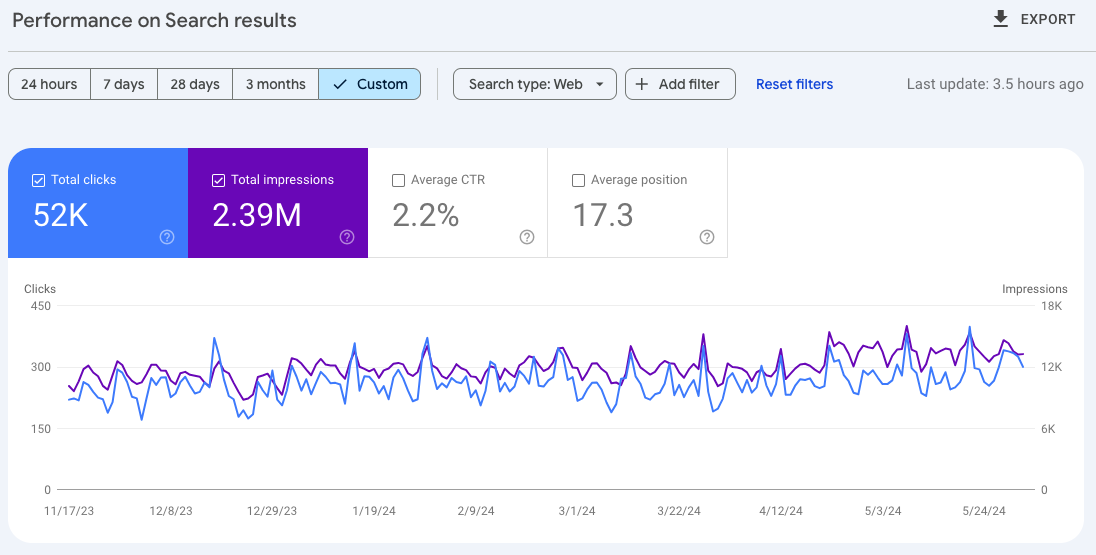
Google Search Console — 52K total clicks, 2.39M impressions, 6 months
If Your Business Needs to Rank in Multiple Countries
The single biggest mistake in multi-country SEO is treating it as multi-location SEO. They are not the same problem. Multi-location SEO means ranking in different cities within one country, one language, one Google index. Multi-country SEO means ranking across separate Google indexes with different authority signals, different competitor landscapes, and audiences using different language patterns even when searching in English.
Hreflang is not optional for multi-country sites. It is the technical foundation that tells Google which version of your content belongs to which market. Without it, you are relying on Google to guess. Google's guesses favour the market with the strongest authority signals, which is almost never the market you most need to rank in.
If your business serves multiple countries and is not generating organic search traffic from each of them, the free SEO audit will identify exactly where the hreflang, geo-targeting, and content architecture are failing and what needs to change to fix it.
Need to Rank Across Multiple Countries?
Start with a free SEO audit. I will review your hreflang implementation, geo-targeting configuration, and country-specific keyword gaps, and send you a prioritised report within 5 working days. No obligation. You keep the report either way.
Get Your Free SEO Audit