

AI SEO Services in Delhi — Get Your Business Cited in Google AI Overviews, ChatGPT and Gemini
AI SEO is the work of getting your business cited when people ask Google's AI Overviews, AI Mode, ChatGPT, Gemini or Perplexity a question your business can answer. I am Sandeep Mehta, an AI SEO consultant in Delhi, and I provide AI SEO as part of my wider SEO services in Delhi, built on the same foundations Google says its AI features rely on: pages that can be crawled and indexed, content that answers the question properly, and a business that other websites describe consistently.
The proof comes from Google's own data. Search Console's Generative AI features report shows one of my clients, a LASIK eye surgery practice in Delhi, earning 76.7K AI impressions in 28 days. Three more clients, in staffing, immigration and B2B manufacturing, show the same pattern. Every AI figure on this page comes from that report.
- Free audit that includes your current AI search visibility
- You work directly with me, not an account manager
- AI visibility measured in Google Search Console, not estimated
The Basics
What Is AI SEO, and How Is It Different From SEO?
AI SEO is SEO aimed at a newer place results appear: inside AI-generated answers, rather than only in the list of links below them. It is not a separate discipline with its own rules.
You will see the same work sold under other names: GEO (generative engine optimisation), AEO (answer engine optimisation) and LLM SEO. The labels differ, but the goal is the same, which is to be the source an AI answer draws on. If you want the distinctions, my GEO FAQ, LLM SEO FAQ and AI SEO FAQ explain where the terms overlap and where they don't.
Google's own documentation on AI features is unusually direct about what this takes: "There are no additional requirements to appear in AI Overviews or AI Mode, nor other special optimizations necessary." A page needs to be indexed and eligible to appear in Search with a snippet. Beyond that, the qualities that earn rankings are the qualities that earn citations.
What does change is how success looks. A person can get their answer from an AI response without clicking through, so visibility inside the answer matters as well as clicks. AI answers also combine several sources, which makes what other websites say about your business carry more weight than it does in a single search result.
How Citation Works
How Do AI Tools Decide Which Businesses to Cite?
AI tools cite pages they can find, trust, and use to answer the specific question being asked. For Google's AI features, that starts with Google's normal search index.
Google builds AI Overviews and AI Mode responses from pages it has already crawled and indexed. Its documentation explains that both features may use "query fan-out", running several related searches across subtopics to build one answer. That is why a page that answers a narrow sub-question clearly can be cited even when it doesn't rank first for the main search. Google also shows AI Overviews only when its systems judge them useful, so they don't appear for every query.
Other AI tools work on the same principle with their own systems. ChatGPT uses its own search crawler, OAI-SearchBot, and OpenAI states that sites which block it will not be shown in ChatGPT search answers. Gemini, Perplexity and Claude can also search the web before answering.
In my client work, the businesses AI tools recommend are the ones described consistently across the web: the same name, address and services on their own site, their Google Business Profile, directories, reviews and articles that mention them. An AI answer that recommends a business is, in effect, summarising what many sources agree on.
One mistake I find in robots.txt files is treating Google-Extended as the crawler for AI Overviews. It isn't. Google states that Google-Extended "does not impact a site's inclusion in Google Search nor is it used as a ranking signal". AI Overviews and AI Mode rely on the same Googlebot crawl as normal search, which is why crawl access and indexing, the core of technical SEO, are the first gate for AI visibility.
Proof, Not Promises
What AI Search Results Have My Clients Seen?
Four of my clients currently appear in Google's AI Overviews and AI Mode at measurable scale. These figures come from each client's Search Console Generative AI features report.
| Client | Period | AI impressions | Daily pattern |
|---|---|---|---|
| LASIK eye surgery practice, Delhi | 28 days, 25 Sep to 22 Oct 2026 | 76.7K | Steady, about 2,300 to 3,400 a day |
| Global staffing company | 28 days, 25 Sep to 22 Oct 2026 | 29.7K | Steady, about 800 to 1,400 a day |
| B2B caps manufacturer, India | 3 months, 23 Jul to 21 Oct 2026 | 1.7K | Climbing steadily |
| Immigration consultant, Lajpat Nagar | 28 days, 25 Sep to 22 Oct 2026 | 1.33K | Rising sharply, about 15 to 160 a day |
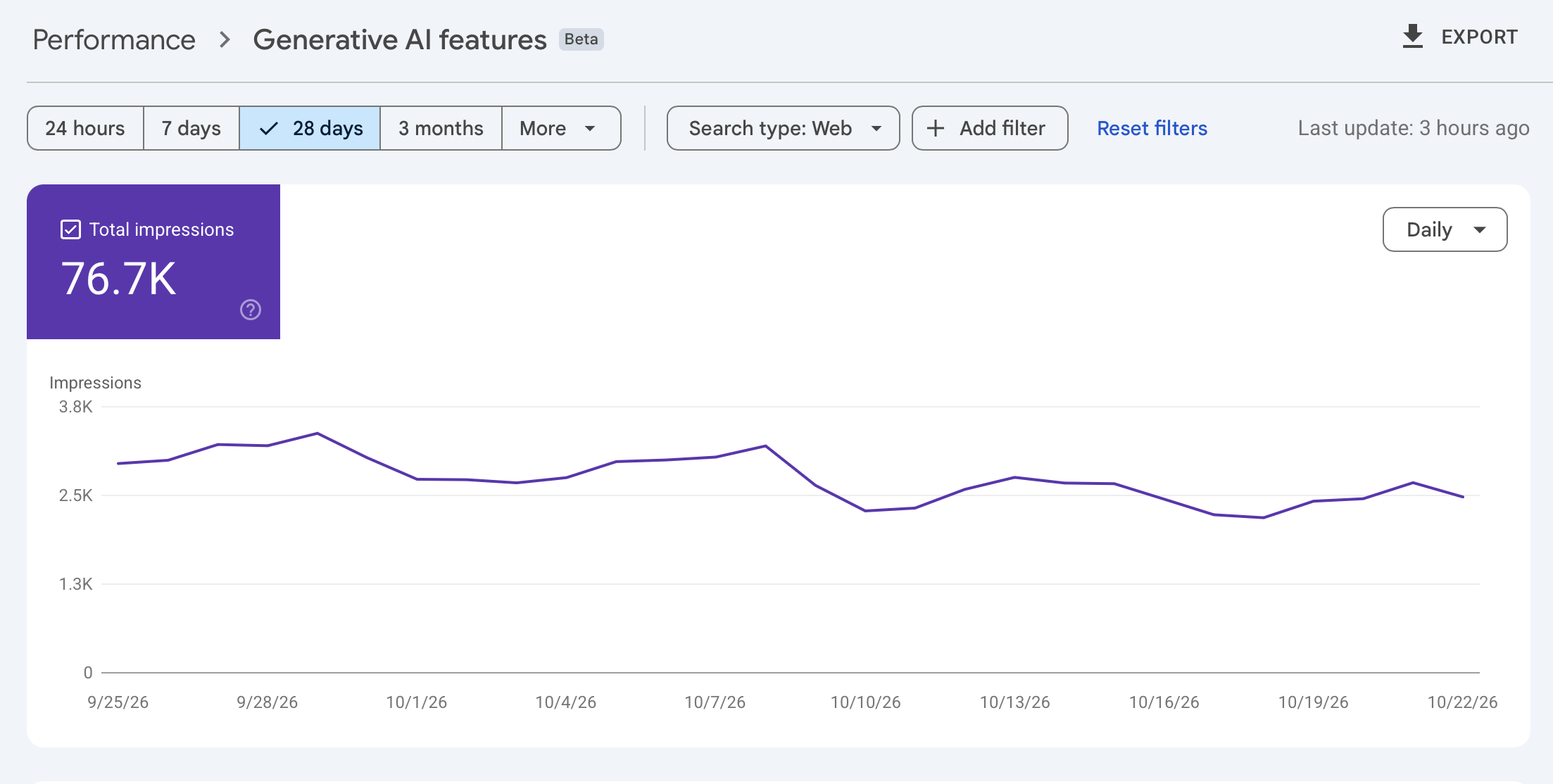
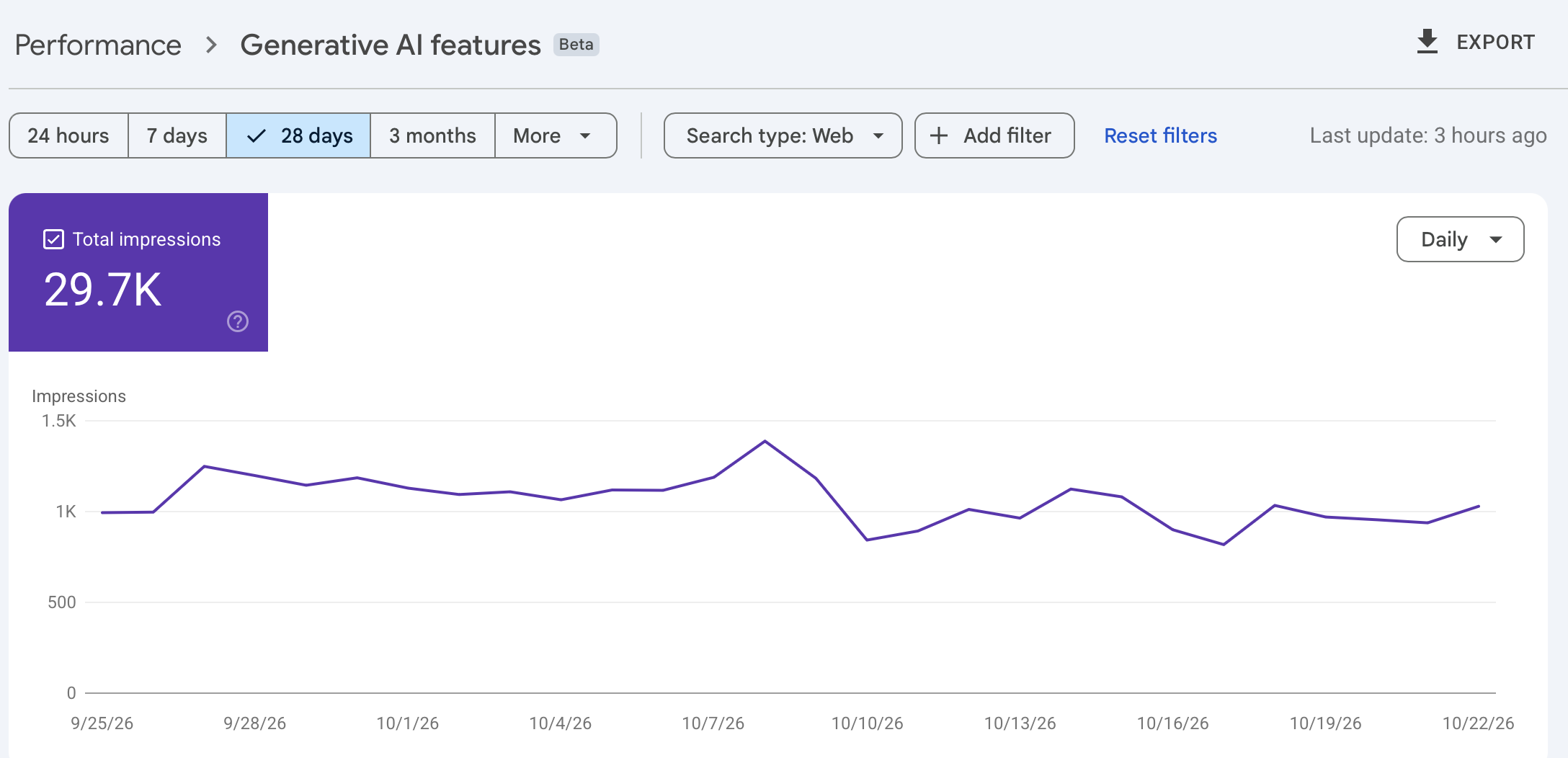
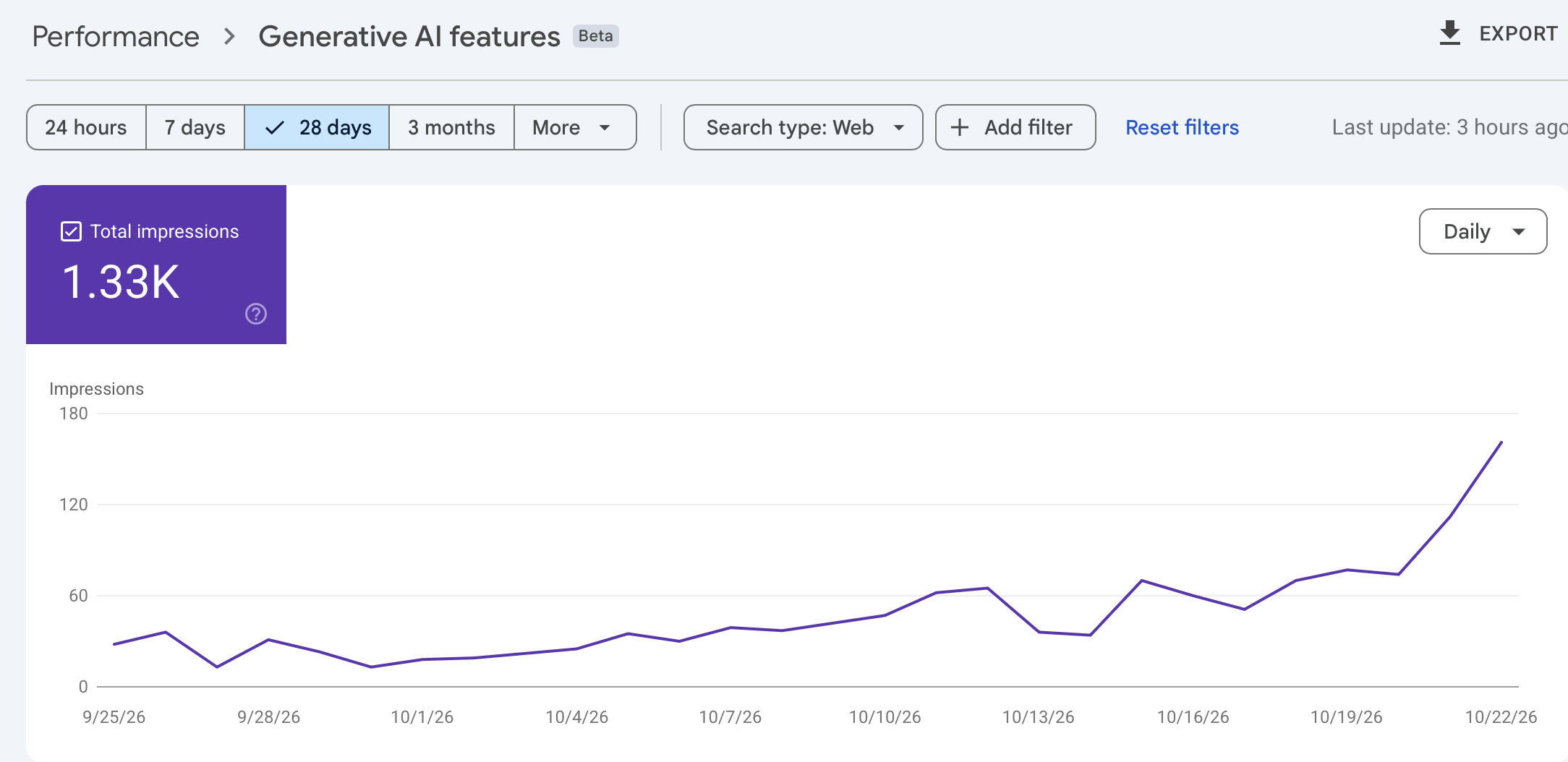
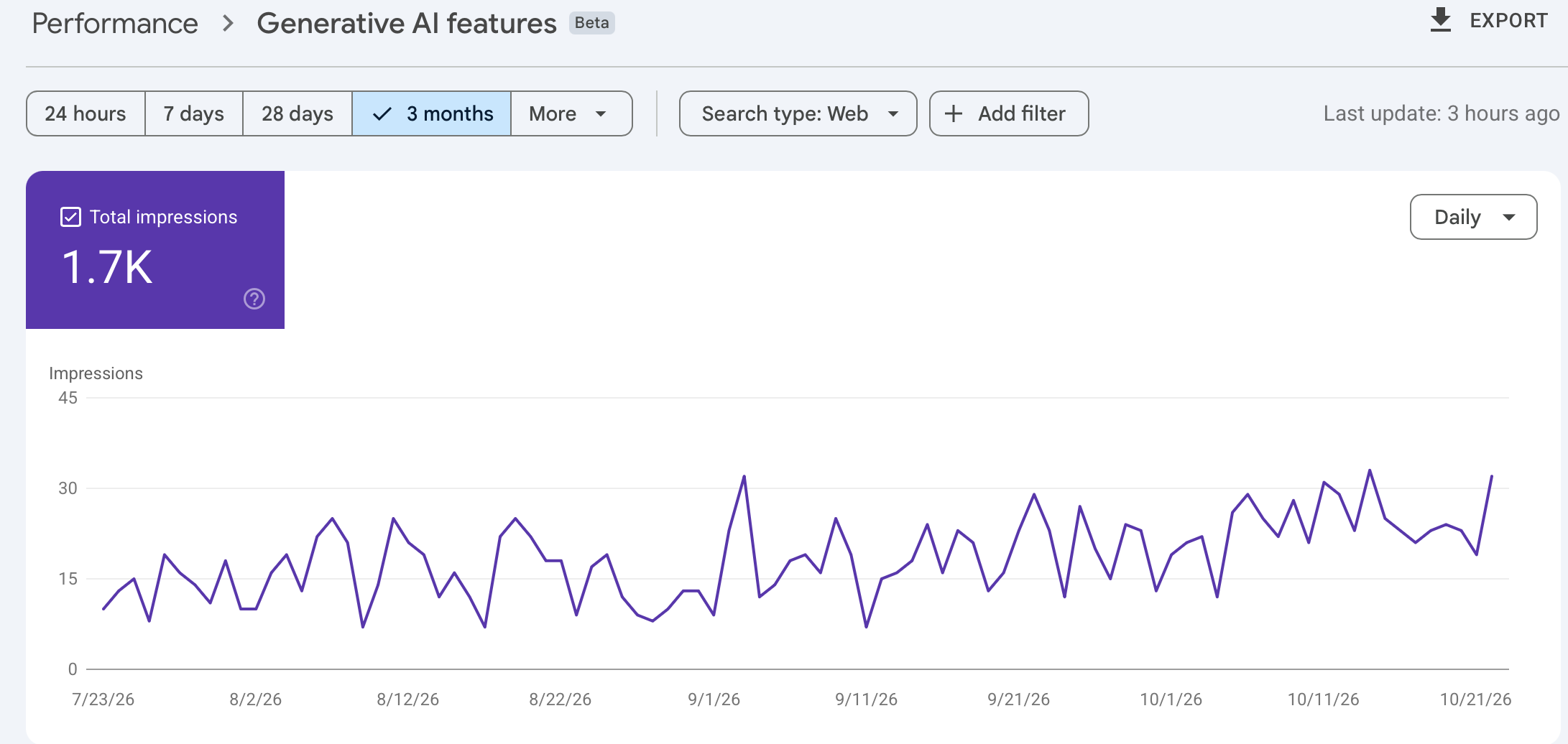
The pattern is the point. The two clients with the largest organic foundations, the LASIK practice (325K clicks) and the staffing company (52K clicks), have the most AI visibility. That matches what Google's documentation says: AI visibility is built on the same base as rankings.
Two notes on reading these numbers. An impression in this report counts when a link to the client's page is shown in an AI Overview or AI Mode response. As of October 2026, the report shows impressions only, not clicks, so these figures measure visibility rather than traffic. I also see these clients named in ChatGPT, Perplexity, Gemini and Claude answers, but those tools don't give site owners measurable data the way Google does, so Google's figures are the only ones I show.
What Is Included
What Does AI SEO Work Include?
Four pieces of work, on top of a sound technical and on-page foundation. These are the same four I used for the clients above.
Content That Answers the Question Directly
Each important question your customers ask gets a clear, accurate answer near the top of the section that covers it, followed by the detail that supports it. I write for the person reading, to the point and factually correct. A passage that answers a person well is also a passage an AI answer can use.
Structured Data That Matches the Page
Schema markup describes your business, services and page structure in a form search engines read directly. Google's guidance is that structured data should match the visible text on the page. It helps search engines understand the page; it is not a shortcut, and Google requires no special schema for AI features.
Genuine Reviews
I set up a simple, steady process for asking real clients to leave specific reviews on your Google Business Profile and relevant directories. Every review comes from a real client. I don't buy reviews and I advise every business against it.
Brand Mentions on Other Websites
Earned mentions in industry publications, directories and articles, with your business name, address and phone number consistent everywhere. This overlaps closely with local SEO, where consistent business details have always mattered.
Alongside these, I keep the technical foundation in order (crawl access, indexing, page speed) and report your AI visibility every month alongside your normal search performance.
What to Avoid
What Doesn't Work for AI Search?
Most of what is sold as special AI optimisation doesn't hold up against Google's own guidance. These are the things I tell clients not to spend money on.
Rewriting Content Specifically for AI
Content reshaped to be extracted by a machine usually reads worse for the person, and Google states no special optimisation is needed. The test I apply is simpler: does this answer the reader accurately and to the point? If it does, it is ready for AI search too.
llms.txt and Other AI Text Files
Google's documentation states: "You don't need to create new machine readable files, AI text files, or markup to appear in these features."
Special "AI Schema"
There is no special structured data for AI features. Schema is still worth using correctly for what it does, but it doesn't unlock AI citations on its own.
Bought Reviews or Mentions
Fake reviews break Google's Business Profile policies and can get reviews removed or a profile restricted. Paid placements disguised as editorial mentions carry the same risk to your reputation.
Tools Claiming to See Google's Internal AI Data
No outside tool has access to how Google's AI features select sources. For Google, the first-party data is the Search Console report.
Reporting
How Is AI Search Visibility Measured?
For Google, with Search Console's Generative AI features report. It shows how often links to your pages appeared in AI Overviews and AI Mode over time, which is the only first-party measure of AI visibility Google offers site owners.
I include this report in every monthly update, next to your normal Search Console performance. Because it currently shows impressions only, I read it together with your normal search data and your enquiries, rather than on its own.
ChatGPT, Perplexity, Gemini and Claude don't offer site owners an equivalent report. For those, I test the questions your customers actually ask, in each tool, on a regular schedule, and record whether and how your business appears.
Choosing a Provider
How Do You Choose an AI SEO Expert in Delhi?
Choose the AI SEO expert who can show you real AI visibility data from Google Search Console, not the one with the boldest claims. AI SEO is new enough that many providers calling themselves a top AI SEO consultant have little proof to show yet. These five checks separate real experience from marketing.
Ask for Search Console AI data from real clients
The Generative AI features report is the only first-party measure of AI visibility in Google. A provider with real results can show it. Screenshots of a single ChatGPT answer are easy to produce and prove very little.
Walk away from guaranteed AI placement
No one controls which sources an AI tool cites. A promise to put your business in ChatGPT or AI Overviews is a promise nobody can keep.
Be wary of llms.txt or "AI schema" as the main fix
Google states that no special files or markup are needed for its AI features. If these are the centre of the proposal, the real work is missing.
Check they do the underlying SEO well
AI visibility rests on technical health, helpful content and a consistent business identity. An AI SEO expert who can't show normal SEO results is unlikely to deliver AI results either.
Know who will actually do the work
With an AI SEO consultant, the person you speak to is usually the person doing the work. With a larger team, ask who handles your account day to day.
Apply the same checks to me. The four client reports above are my evidence. Whether I belong on a list of top AI SEO experts in Delhi is for clients and other websites to judge, not my own page. What I can do is show you the data.
An Honest Answer
Is AI SEO the Right Investment for Your Business?
Not on its own, and not for every business. If your site isn't indexed properly, loads slowly or doesn't rank for anything yet, AI search work has nothing to build on. In that case I'll tell you during the audit to fix the foundation first.
It is a strong fit if you already have some search visibility, your customers research before they buy, and you want your business named when they ask an AI tool for a recommendation. Keep in mind that AI Overviews don't appear for every search, so the opportunity is larger in some industries than others. The free SEO audit shows which applies to your business.
Before deciding, most business owners ask the same few questions about guarantees, cost and which AI tools this covers. Here are direct answers.
FAQ
What Questions Do Delhi Businesses Ask About AI SEO?
Can you guarantee my business will appear in ChatGPT or AI Overviews?
No. No one controls which sources an AI tool cites, and Google shows AI Overviews only for some searches. What I commit to is the work that makes citation likely, measured honestly in Search Console every month.
Is AI SEO separate from normal SEO?
No. It is built on the same foundation: crawlable, indexed pages with helpful content and a trusted business identity. Treating it as separate usually means paying twice for the same work.
How much do AI SEO services cost in Delhi?
My SEO retainers start at ₹14,999 per month, and AI search work is built into the SEO rather than sold as a separate add-on. Full pricing is on the SEO packages page.
Which AI tools does AI SEO cover?
Google AI Overviews and AI Mode, which I measure in Search Console, plus ChatGPT, Gemini, Perplexity and Claude, which I test directly with the questions your customers ask.
Do you work as an AI SEO consultant for businesses outside Delhi?
Yes. I am based in Janakpuri, New Delhi, and the work is done online, so location doesn't limit it. Two of the four clients on this page show that: a staffing company targeting job seekers in Ireland, Kuwait and Germany, and a caps manufacturer selling across India.
Do I need an llms.txt file?
Not for Google. Google's documentation states that no new machine-readable files, AI text files or markup are needed to appear in its AI features.
How long does AI SEO take to show results?
There is no fixed timeline, because AI visibility depends on your pages being indexed and trusted first. For one client, daily AI impressions rose roughly tenfold in four weeks, on top of SEO work that was already under way.
Find Out Where Your Business Stands in AI Search
Request your free SEO audit and I will review your site's technical health, content and business details, and check how your business currently appears in AI search. You get a prioritised report within 5 working days, with no obligation.
Get Your Free SEO Audit →